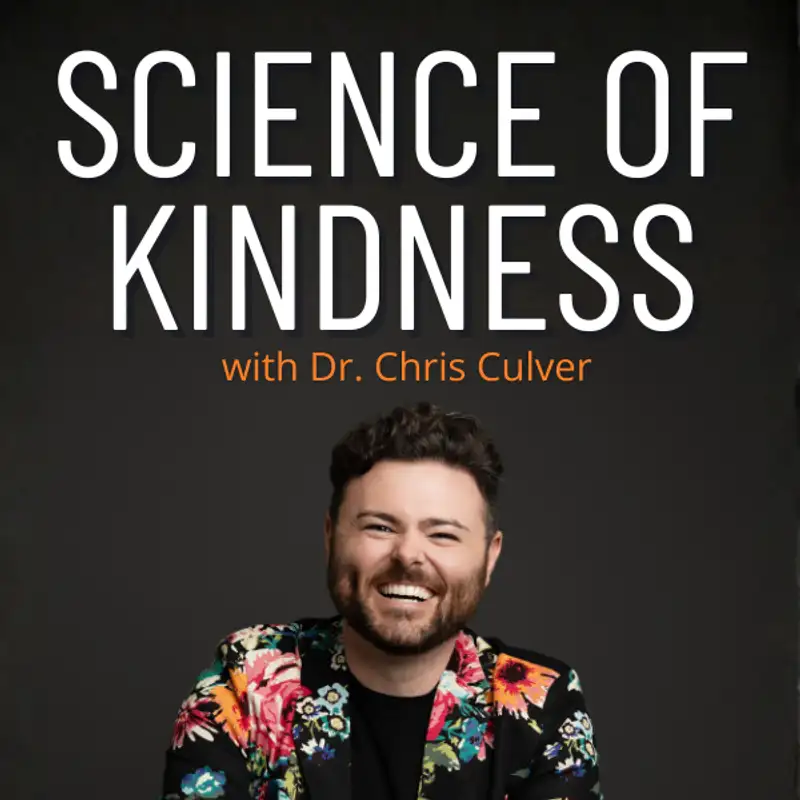
Welcome to the Science of Kindness podcast. I'm your host, doctor Chris Colbert, I'm so grateful that you've joined us today. We share real stories and give you tips, tricks, and strategies to fit kindness into your life. Enjoy and know that you are a bright light in this world. Hey there and welcome to the science of kindness.
Dr. Chris Culver:I am Doctor. Chris Culver. I'm the host of this podcast and I'm so excited to be here on our first episode. Did you know that kindness lowers stress? It strengthens your brain and literally rewires how we connect with ourselves and with other people.
Dr. Chris Culver:That's the science. But for me, kindness is much more personal than just the science stats that I shared there. So many of us remember the pre k rule of treating others the way we wanna be treated. Right? And we oftentimes give out kindness to others more so than we give ourselves.
Dr. Chris Culver:I remember asking in a in a keynote presentation recently, by show of hands, that exact question. How many of you remember when someone was kind to you? Lots of hands were up in the space and how many of us are kind to ourselves the same rate we are kind to someone else? And lots of hands went down. And I think about when we choose kindness for ourselves, that's where it's really powerful, really powerful.
Dr. Chris Culver:As I shared, my name is Doctor. Chris Culver. I'm a kindness advocate and kindness researcher, but that's not where my story started. I'm from a divorced family. My mom and my dad separated when I was six years old.
Dr. Chris Culver:My mom moved from Fayetteville, North Carolina to Tulsa, Oklahoma. My dad and my stepmom Charlotte stayed in Fayetteville. And so I split time between Oklahoma and North Carolina two times throughout the year. So in the summer, my brother Zach and I would go to North Carolina and at Christmas. Having four parents was my normal.
Dr. Chris Culver:I thought that was everybody's experience. And what I realized is that wasn't I was super grateful to have four parents who poured into me and provided me opportunities. And it wasn't always easy. They didn't always get it right, but I can tell you they did their absolute best. My stepmom, Charlotte passed away on 06/23/2023.
Dr. Chris Culver:And so God rest her soul, I hold the lessons, the kind things that she taught me whether she realized it or not with me. My mom and my stepdad also have a farm in Wyandotte, Oklahoma. So people don't believe that I grew up on the farm on the weekends. So I always have picture proof evidence that I did the dang thing. And so I just wanna stop for a second and say thank you to all of our ranchers, our farmers, our agricultural workers.
Dr. Chris Culver:That's just really hard. It is really hard work. But I'll tell you what, had I not had the opportunity to be down on the farm, I don't know that I would've learned the the definition of hard work, perseverance, tenacity, grit, some of those things that we need to be really positive contributing members of society and to have those life skills to move us beyond just our childhood. As I mentioned, my brother Zach, he is three years younger than I am. We we split that divorce family time a lot together.
Dr. Chris Culver:So we would travel back and forth, but we we came close through those times as well. And I share I share his story with you because he had the opportunity to work in the salon of the Dallas Cowboy cheerleaders in Dallas, Texas, and I'm really, really proud of him. And I think it really just reiterates the fact that so many of us don't have to go to college to be successful. I think there's pathways and opportunities for everyone to find their lane, to share their gift, to share their light with the world, and that's the power of kindness, making sure that we're doing things that are best for ourselves. We're gonna get there.
Dr. Chris Culver:We're gonna get there, but I had to get a little bit of a teaser and give some highlights of my brother, Zach. I'm also with my partner, Kelly. Doctor Kelly Forbes, we've been together for twelve years this November. That is crazy to me. He is a classroom educator, a college professor, and, yes, he's running for lieutenant governor this time.
Dr. Chris Culver:So we are on the campaign trail for the next year, and it's been exciting to connect with lots of Oklahomans and lots of folks across the state, but proud of him and honored to walk that path with him. I am a former classroom educator. I'm still working at the collegiate level. I share this with you because I have loved school since I was a little kid. There are pictures of me sitting at a desk with my own nameplate.
Dr. Chris Culver:My grandparents got me a dictionary for my birthday, and my dad jokes that my tenth birthday party was literally an office depot. I don't know that other people have that same experience, but I knew that I was gonna be a teacher from a young age. When other folks were getting toys and balls and soccer gear, I was getting pointers and globes and index cards. Like, I knew that I was gonna be a teacher, although that wasn't always my path. In third grade, I carried my multiplication fact cards to school in a briefcase.
Dr. Chris Culver:But my dad says that I couldn't even say briefcase, so I literally called it my ashate case. And I think it's so funny. And in fifth grade, I planted a tree at our school for a sponsorship in a suit and tie. And why am I telling you these stories? Because as humans, we're wired to fit in, to belong, to be seen, to be heard, to be valued, to be respected, all forms of kindness for ourselves.
Dr. Chris Culver:And as someone who's navigating divorced families, splitting time between Oklahoma, Tulsa, Wyandotte, North Carolina, it's really hard to figure out where do you fit in, where do you belong, where are you seen, where are you valued, where are you respected. And at school, I think I found that safe space in the elementary years. And so oftentimes, I was doing the most clearly with my Ashette case and my tree planning gear. But I think, again, I was looking for that belonging, and it's evident. Because in fourth grade, I had this fantastic wind suit on.
Dr. Chris Culver:Fantastic. And friends, I don't understand sports ball at all, full stop. And this kid behind me had this basketball, and I asked him, I said, hey. Can I borrow that basketball for my school picture? And he said, sure.
Dr. Chris Culver:And so in my school picture, I had this fantastic track suit on with this basketball, and I take it home, and my mom thought I made the basketball team. So friends, that is my one and story highlight of being an athlete in any regard. But I share these things with you because you can see from third, fourth, fifth grade, I was searching for belonging, looking for ways to fit in, looking to be seen, heard, valued, and respected for who I am. So it would be no surprise that in middle school as this eclectic child that I would be bullied and picked on and made fun of. And it would continue into high school, oftentimes rooted in shame, not wanting to own the things that happen, being tased by students, being put down, being made fun of for the way I talked, the way I walked, the way I looked, all of the moving pieces.
Dr. Chris Culver:And I share this with you today not for sympathy, but for solidarity. Because there's someone who's listening to us today that is either helping a young person navigate this, who's navigated it themselves, who are navigating it right now. And I share that with you to say, I see you. I see you, and that's okay. Because here's the deal.
Dr. Chris Culver:There's somebody out there who needs your story and needs you. So keep being you because that's what teachers told me. Teachers literally helped save and change my life. In high school, so many of them helped me see my strengths and the values that I brought to the space rather than a lot of the pessimistic things that my classmates or grade level students essentially would say about me. And I know now looking back, so many of them have reached out and apologized and shared things.
Dr. Chris Culver:And I know we all say it as educators, kids can be mean. Right? But when you're on the receiving side, it really does hurt. And so I always say thank you educators. I'm rooted in gratitude for every educator, for every teacher, for every adult who's a mentor for a young person, who is the dealer of hope and belief, who gives them kindness, allows them to see the value and the prosperity they bring to the space because it's easy to forget that when we're hearing all the negative things about ourselves.
Dr. Chris Culver:Not only did I hear it at school, but I also heard it at home. Unfortunately, my stepdad was pretty verbally abusive. He's gotten better over the years. And I think that stems from a lot of stress. I'll share that.
Dr. Chris Culver:I'll share that what stress can do to our body, how that cortisol levels can impact us and where kindness comes into play. And so after high school, I would graduate high school. It was a long road to get there. And I was going to pursue an English education degree. But friends, my parents, my mom and my stepdad discouraged me from doing so.
Dr. Chris Culver:They said, listen, you're gonna make no money. You're gonna be poor, you're gonna be broke. All the things that we've heard before. And essentially I was like, listen, give me my cardboard box, give me my colored markers. I'm gonna make the best of this.
Dr. Chris Culver:And so although that was my mindset, I was discouraged. And so three separate times I attempted to get a business management degree, but friends, I couldn't do statistics. I couldn't do micro macroeconomics. I couldn't do accounting. I couldn't do any of those things.
Dr. Chris Culver:And again, I share this because I know other folks may have been navigating this too. So I dropped out three times. Three times I dropped out of college. But it was on the fourth try that I really started to pursue that English education degree that I found my path. I'm not saying that it was easier.
Dr. Chris Culver:I'm saying that I knew that it was my calling. And so I would go on to graduate with my bachelor's in English education, and I would go on to get a master's in school administration and ultimately a doctorate in educational leadership and administration. I wanna pause here for a second and tell you the story as getting my doctorate. In 2022, my dissertation chair asked me, hey, what kind of study are you going to do for your dissertation journey? Are you gonna do a qualitative study or a quantitative study?
Dr. Chris Culver:And listen, I was just vulnerable and cheered. I was scared to death of statistics and microeconomics and all of that math. Math is not it for me. Clearly, was an English teacher. But I wanted to prove to myself that although I couldn't do statistics when I was 18, 19, 20, 21, I don't remember what ages those were whenever I was doing that, but I could do it now.
Dr. Chris Culver:And so I looked at her confidently in the face and I said, I'm gonna do a quantitative study. And I successfully defended that quantitative study and graduated in May 2023. But I I'm not sure what my how I survived that, to be totally honest. It was a little wild and crazy, but it taught me a lot. It taught me the power of growth mindset, not being defeated, being 1% better today than I was yesterday, 1% better tomorrow than I am today.
Dr. Chris Culver:And those are all forms of kindness that we're gonna get to. So I want you to know that even if you can't do something right now, you can do anything you put your mind to and just being improving every single day. I'm the former president of the Oklahoma Association for Bilingual Education. I'm a former high school English teacher. I'm a former middle school administrator.
Dr. Chris Culver:And most recently, I served as an executive cabinet level administrator in a local district here in the Oklahoma City Metro Area. And I walked away from pre k through 12 education in June 2023, and I started as an adjunct professor at Oklahoma City University working with new teachers and new leaders going into the field of education. And I also started what I call the kindness tour on a mission to make kindness go viral as a kindness advocate and kindness researcher. How many of you remember, and I know this is a rhetorical question, but how many of us remember our first position that we interviewed before coming out of college? Whether it be a teaching position, our first entry level position, whether we're be an engineer, a mechanic, whatever it is.
Dr. Chris Culver:How many of us remember that very first interview? I remember it so well. And my first teaching interview was awesome. I felt like we had great connections. I had the job and I loved the space where I taught my first couple years of of school.
Dr. Chris Culver:And I think back of getting my masters and I said I would never get a masters in school administration. And I remember getting my masters and I like, okay. I'm I'm gonna be a principal. I'm gonna do this thing. Right?
Dr. Chris Culver:Well, friends, let me be really vulnerable with you. I interviewed way more times than I care to share about becoming an assistant principal or an administrator in a local district. More times than I I mean, double digit numbers here, friends, double digits. And I was so defeated. I was like, I've gone to school, I have the expertise, I have all these things, why is it not happening?
Dr. Chris Culver:What I realized is once I finally landed the first position was everything happens for a reason. Everything is teaching us something, showing us something. We're being guided to learn something. Should we choose to see it that way? Should we change to change our perspective and view that?
Dr. Chris Culver:And so my very first administrative position, I got hired three days before school started. I was so pumped. I was so excited. I was on cloud nine. I had waited for this moment.
Dr. Chris Culver:But friends, Bill Marklin leaves us this quote that says, culture is how employees' hearts and stomachs feel about Monday morning on Sunday night. And unfortunately, that was a frequent feeling I had on a regular basis. It was so bad in this culture where I had worked. Remember I had I had I had worked so hard to achieve this milestone. And when I got there, the culture was so toxic.
Dr. Chris Culver:The principal that I worked for, excuse my language, was a mix between Satan and Hitler. We called her Schittler. And so friends, it was so toxic. I was waving the white flag to central office. I was like, help us do something.
Dr. Chris Culver:And nobody was returning the call. Nobody was taking it as seriously as all of us that were being impacted by the negative work and toxic environment that we were navigating. Rooted in shame, I'll be honest, rooted in shame, I called the employee assistance helpline. I had to seek the free therapy sessions. I had to go to the six free counseling sessions to figure out what's going on.
Dr. Chris Culver:Because what I realized is we can't control other people, we can only control ourselves. And it was in those therapy sessions, it was in those moments of weakness, in that really toxic climate, in that really destructive culture that I found the power of kindness. You see, I can't control what Schittler was gonna do in that situation. But what I can control is my actions, my thoughts, my perception, and how I respond to situations. That's the power of kindness.
Dr. Chris Culver:Strong people choose kindness because lifting others up takes courage and heart. And friends, I'm not talking about the easy days where it's easy to choose kindness. I'm talking about the toxic environments, the hardships, being cut off at a red light, dropping your phone, walking through water, all those hard moments where it's easy to get down, to get frustrated, to be in inundated in all the negative emotions and feeling. Those are the moments. Those are the times where kindness is needed is needed the most.
Dr. Chris Culver:And so that's what I mean. Strong people choose kindness because lifting others up takes courage and heart. And for so long, so many of us think that kindness is about making big promises, toxic positivity, and flattering people. But the reality is that's not what kindness is about. Kindness is about offering real support, giving specific praise to people, remembering the details, being honest, truly listening.
Dr. Chris Culver:The research says that when we give our most undivided attention, that's the most sacred gift we can give to someone, paying attention, being kind to them by looking them in the eye, listening to what they have to say, but also celebrating others wins, standing up for others, and acting with empathy. I share this with you because my dissertation research showed that in order to maintain retention and to motivate employees, individuals need relationships, trust, empowerment, autonomy, recognition, clear and transparent communication. And when you break down those factors, those six factors or what I call the five plus one framework, they all tie back into kindness. Those exact same things that we were talking about, support, praise, trust, autonomy, listening, empathy. All of those moving pieces are so important because when there's kindness rampant and evident in a space, people are 10 times more engaged in their jobs, 10 times more engaged in their activities, that increases their mood by 90%.
Dr. Chris Culver:As humans, we're wired to belong as I mentioned earlier in this episode. And when there's kindness evident in this space, there's belonging fostered by 80%. And friends, kindness is good for the doer and the receiver, but also the observer. When someone sees, receives or gives kindness, they're 75% more likely to give out kindness to other people. And it reduces stress by 28% and it increases motivation by 50%.
Dr. Chris Culver:I share these alarming statistics with you because here's the deal, kindness isn't delusional. Kindness isn't one more thing. Kindness is the thing. And so many people think that it is a weakness, It's the fluff, it's sunshine, it's rainbows, it's butterflies. And sure, we can classify some of that as confetti kindness as Huston and Kraft tells us.
Dr. Chris Culver:But we also need to know that deep kindness, listening, paying attention, greeting people, acknowledging folks, honoring who they are, all of those pieces really matter. And I share that with you because in my journey of learning how to be a teacher, learning how to be an administrator, learning how to be a leader, Kindness really was the through line for my leadership, for my teaching and for who I am as an individual. Kindness not only saved my life and changed my life in those dark days of 2019 and again in 2023, but in '23 I chose differently. While the culture was toxic, the leadership was toxic, I chose myself and I chose to walk away. Because what I realized is I can't control those individuals.
Dr. Chris Culver:All I can do is choose myself, choose my thoughts, choose my actions. And when I choose kindness, when I'm kind to my mind, when I say things to myself that I would say to somebody else, that's where it all matters. What do I mean by that? I was working with an educator in Florida not too long ago. She vulnerably shared she was in her car and she was beating herself up in front of her daughter and her daughter interrupted her and said, mom, if I were to say those things about myself, you would be so frustrated.
Dr. Chris Culver:You'd be so angry. So she said, mom, you can't say those things about yourself. And I echoed her daughter. I said, you can't. You've gotta be kind to your mind.
Dr. Chris Culver:So hear me friends, If you wouldn't say it to a friend, as you go throughout the day, as you go throughout the week, as you go throughout your life, please don't say it to yourself because you're worthy of all the love and light. We need your gift. We need your light here in this world because kindness isn't about being nice. It's about making sure that we create spaces where everyone is seen, heard, valued, and respected. As a leader, I made sure I had an open door policy.
Dr. Chris Culver:As a motivational speaker, as a kindness advocate, as a kindness researcher, I am intentional to make sure I'm listening to folks, hearing what they had to say, affirming their value, right? And I think about all of us in our respective spaces where we work, or where we serve, or where we lead, or where we work with children, or whatever it may be that we do. And here's the deal, when you show up as your authentic self, you smile, you greet people with their name, when you let people know that you are glad they are there that day, all of those things may seem minuscule to you, but they signal belonging cues to somebody else. Let them know, hey, I'm safe here. I'm trusted here.
Dr. Chris Culver:Right? And as I look back on my own journey from my childhood through my middle school years, to my high school years, to my educational career, and even where I am now, we all want belonging. We all want connection. We all want compassion. Those are all forms of kindness.
Dr. Chris Culver:So kindness isn't the rainbows, the butterflies, the sunshines, the cookies, all of those things. And while they're a part of the kindness metric, the deep kindness that we're looking for are those belonging cues, the empathy, seeking to understand, ask questions, and assuming positive intent. I think back to my childhood, I think back to working with Schittler, and had those things happen, would the dynamic have changed? Would those things have changed? And when I tell you, I don't know, I really mean that.
Dr. Chris Culver:But what I can tell you is I reflect back after all those interviews that I had as an administrator to finally land my first administrative position. If you remember I shared that I think everything taught us something, every experience is teaching us something. In short, the moment 2018, 2019, 2020, I didn't see that. I didn't see it, I'll be vulnerable. But as I stepped out in '22 '23 and I was looking back and I was wrapping up my dissertation journey, I realized had I not landed that first administrative position, had I not worked with that principal who was incredible at logistics, but terrible at relationships, had I not had that experience, I don't know that I would have dove into my dissertation research.
Dr. Chris Culver:I don't know that I would have ever called the employee assistance helpline. I don't know that I would've found the power of kindness the way that I did or the science of kindness. And so when I share this with you vulnerably, I want you to know you're not alone. Whatever you're going through today, we are all navigating things that are similar because we all have an invisible backpack. May we operate with grace.
Dr. Chris Culver:May we operate with compassion. May we operate with empathy, assuming positive intent, asking questions, and knowing that we are greater than great. So I mean this. If you didn't wake up today saying you're greater than great, I hope you look in your mirror today as you're driving in the bathroom, wherever it may be. Look yourself in the eyes for five seconds and say, I am greater than great, and I'm doing my best.
Dr. Chris Culver:Because here's the deal, we have the power to choose. Choosing to be kind, especially when life is tough, when life throws lemons, when life is lifing, as we like to say at the university. When you choose kindness during those times, that's where you show strength in your character and purpose. And so my journey hasn't always been easy, but I'm passionate about the science of kindness. I'm passionate about sharing what kindness can do for you, what it can do for me, what it can do for our world.
Dr. Chris Culver:And I'm on a mission with this podcast, with the blog, with all the things that I have going on to make kindness not one more thing, but the thing. So I hope you join in. I hope you enjoyed our first episode of the science of kindness, getting to know me. I'm excited to continue this journey with you sharing more around the science of kindness. Tune in, make sure you turn the bell on, subscribe, follow, turn on all the alerts, all the things.
Dr. Chris Culver:If you're looking for more information, be sure to check me out on all social media channels doctor Chris Colver. You can also find my website, www.doctorchrisculver.com or wwworangesparrow.org. It's been a joy to share this space with you. As I always say, if you can't find the light, be the light. And sometimes the light you're looking for is the one that you carry on the inside.
Dr. Chris Culver:Know that I'm grateful for you. I'm rooting for you. And from the bottom of my heart, I love you. Have an amazing, amazing day.
Outro:The Science of Kindness podcast is hosted by doctor Chris Culver. Our editor is Billy Mark. Our executive producer is Jake Dobreins. This podcast was created in conjunction with Theophany Media.